By the summer of 1793 the French Revolution was eating its own. The moderate Girondin deputies had been driven out of the Convention by the radical Montagnards, and some of them fled to Caen in Normandy to raise a revolt against Paris. In that city lived Marie-Anne Charlotte Corday, twenty-four years old, educated at a convent and living with an aunt. She read Plutarch, sympathised with the Girondins, and had decided that one man was responsible for the bloodshed: Jean-Paul Marat, the journalist whose newspaper had called for heads to fall.
The Horror
Corday left her aunt on July 9, 1793, travelled to Paris and took a room at the Hôtel de Providence. On the morning of July 13 she bought a table knife with a black handle and a sheath at the Palais-Royal. According to the trial papers it cost forty sols. She then went to Marat’s home in the rue des Cordeliers, claiming she had information about Girondin plotters in Caen. She was turned away at the door, and on that point the sources disagree: some name Marat’s companion Simonne Évrard, others her sister Catherine.
She came back that evening. By most accounts she raised her voice at the door, and Marat, who was working in his bath, called out for her to be let in. Marat spent much of his time in a medicinal bath because of a painful, chronic skin disease; its cause is still argued over, and a 2020 study suggested a fungal infection. He wrote down the names she gave him. Then she drew the knife and stabbed him once in the chest. The blow was fatal. The words usually given as his last, “Aidez-moi, ma chère amie” (help me, my dear), were called to Simonne. The trial papers put the killing between seven and eight in the evening of Saturday, July 13, 1793.
Corday made no attempt to flee. She was seized in the room and, according to accounts of the time, officials had to protect her from a crowd that wanted to lynch her. She was questioned by the president of the Revolutionary Tribunal, Jacques Bernard-Marie Montané, on the morning of July 16. The court was convinced that a young woman could not have acted alone and pressed her to name accomplices. She told them she had planned and carried out the act on her own, and the deputies Duperret and Fauchet, whom the court suspected, were cleared.
Her trial opened at eight on the morning of July 17. Nineteen or twenty witnesses were heard, and to each account of the killing she answered, according to the court record, “c’est vrai”. She had asked for the Girondin deputy Gustave Doulcet to defend her, but her letter did not reach him in time, and the court appointed a lawyer, Claude-François Chauveau-Lagarde. Some historians suspect the prosecutor Fouquier-Tinville of delaying the letter, but that is a suspicion, not a documented fact. Her reported claim that she “killed one man to save a hundred thousand” is attributed to her in the standard accounts but does not appear in the transcription of the trial papers, so treat it as a traditional paraphrase. The jury answered yes to all three questions: she was the author of the killing, she acted with criminal intent, and she had planned it in advance. She was sentenced to death, to be taken to the scaffold in the red shirt worn by condemned murderers, and her property was forfeited to the Republic.
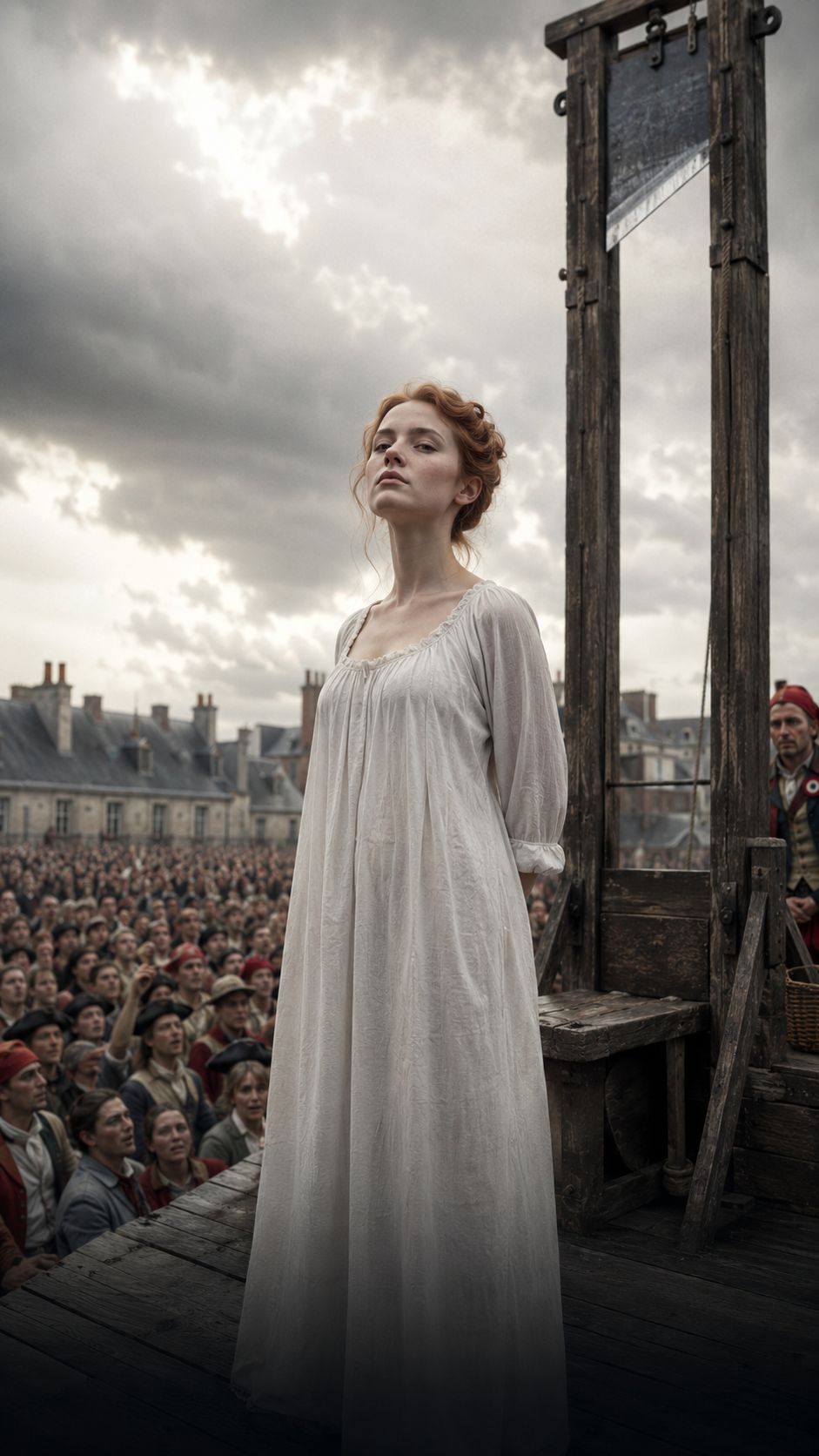
At about half past six that evening she was taken by tumbril to the Place de la Révolution, now the Place de la Concorde, and guillotined by Charles-Henri Sanson. Four days had passed since the murder. Her body was examined afterwards, and a crude examination found she was a virgin, which the authorities took as evidence that no lover had put her up to it.
Legend: the slap
The story told most often is that one of the executioner’s men picked up her severed head and slapped its cheek, and that the face flushed with indignation. The slap itself is recorded: a man named Legros, who was jailed for three months. According to Sanson’s diary he was a carpenter hired to repair the guillotine, not Sanson’s assistant. The flushed face and the claim that the head showed feeling is legend, with no scientific support, and the supposed blinking and expression are later embellishment.
The Modern Relic
Marat was given a state funeral organised by the painter Jacques-Louis David on July 16, 1793, and buried in the garden of the Cordeliers convent. In September 1794 his remains were moved into the Panthéon, and in February 1795, after the fall of Robespierre, they were taken out again. David’s painting of the dead Marat, one arm trailing over the side of the tub with a letter in his hand, made him a secular martyr. The painting has been in the Royal Museums of Fine Arts of Belgium in Brussels since 1893. Studio copies hang in other French collections, including the Louvre. The note in Marat’s hand is David’s invention, not the text of Corday’s real letter.
The Musée Grévin in Paris displays a copper bathtub as the one in which Marat died. It was publicised by Le Figaro in 1885, the Musée Carnavalet refused to buy it for want of proof, and the Grévin acquired it in 1886. No documented provenance connects it to Marat, so it should be seen as a relic of the legend rather than of the murder. The house stood in the rue des Cordeliers, on the Left Bank near the old Cordeliers convent (the street has since been renamed); the exact number is given differently by different sources and the marker on the map is approximate.