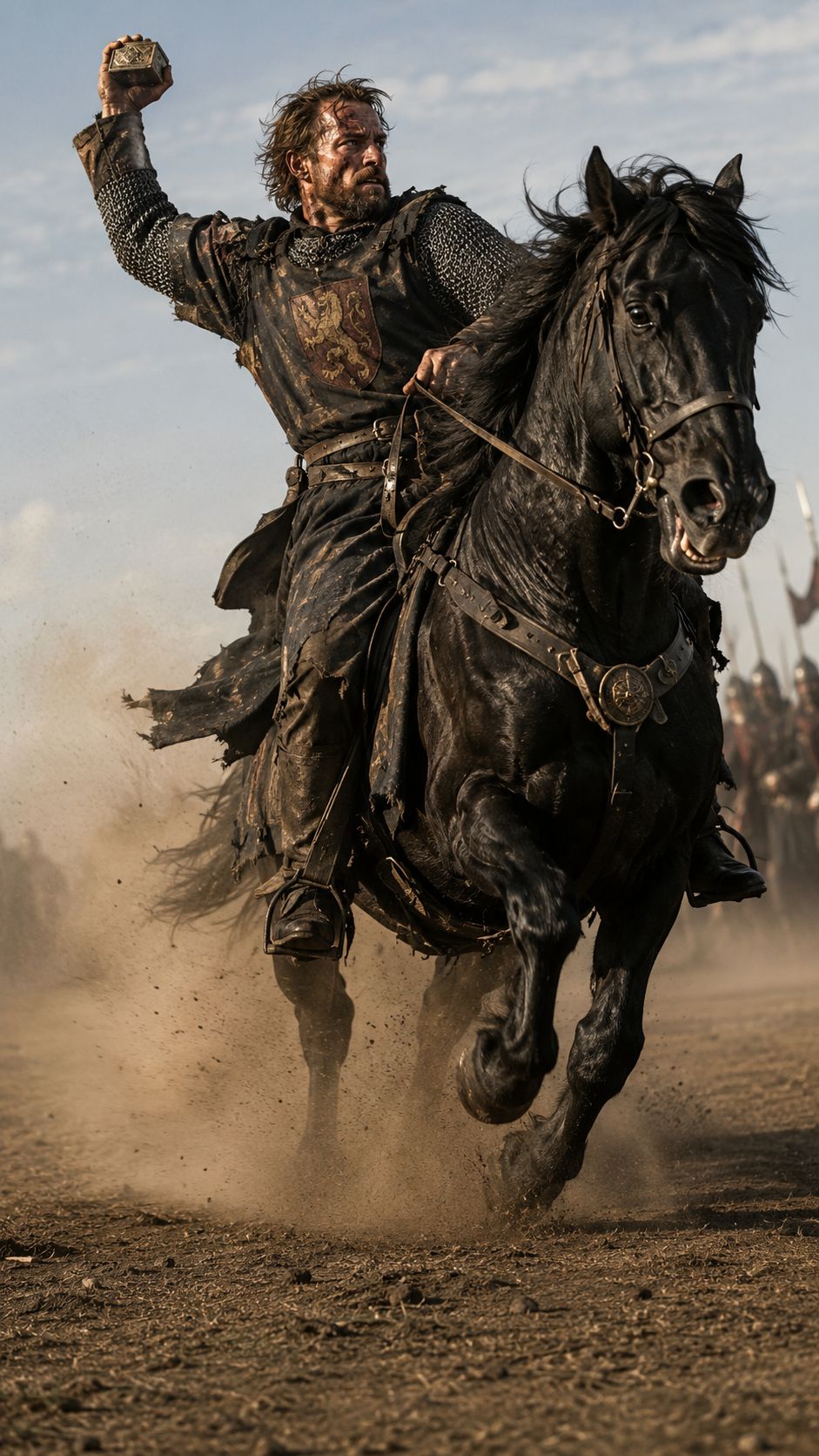
Johnnie Armstrong was a cattle thief on a grand scale. From his base in the Borders he raided deep into England, and in the 1520s he was a power on the frontier that neither Edinburgh nor London fully controlled. He is remembered less for the raiding than for how it ended: a Scottish king, a promise of safety, and a row of bodies hanging from trees.
The Horror
The documented outline is short. John Armstrong of Gilnockie, a member of the Armstrong family of Liddesdale and Eskdale, was one of the leading Border reivers of his day. In 1527 he is recorded burning Netherby in Cumberland, and in 1528 the English warden Lord Dacre burnt him out at Canonbie. He was excommunicated by the Archbishop of Glasgow, and he operated under the protection of Lord Maxwell.
In 1530 the young James V, still in his teens, took the problem of the Border in hand himself. He rode south with a large following. The king’s household book places him at Caerlanrig, in Teviotdale, on Tuesday 5 July 1530, and that is the strongest surviving date for the event. Armstrong was hanged there with a number of his men. He went, according to the tradition most accounts repeat, under a promise of safe conduct, and was seized and executed without a trial.
How many died with him is not settled. The usual figures are thirty-six companions, making thirty-seven hanged in all, but some accounts speak of between thirty-six and fifty dead, and one popular retelling suggests the number of men who rode out with him may have been anywhere from twenty-four to fifty. The exact day also varies between sources: 5 July is the date the king is known to have been at the place, which is not quite the same as a dated record of the hanging itself. Treat the precise day and the head-count as approximate.
What can be said with confidence is that a Border chieftain of real standing was put to death by his king on the king’s own initiative, that the place was Carlenrigg (Caerlanrig) near the head of the Teviot, and that it was remembered in the Borders as treachery.
The part that is ballad
Almost everything quotable about Armstrong’s last hour comes from the ballad “Johnie Armstrong” (Child ballad 169), not from a record made at the time. In the ballad the king sends a letter promising safety, Armstrong rides to court in his finery, asks for a pardon and is refused, and is brought down by a treacherous attack from behind. His young son vows revenge. Popular retellings add a scornful speech to the king in which he calls himself a fool to seek grace at a graceless face. That speech, the reported insult from James, and the glittering display of gold and silk are the stuff of song. No eyewitness text survives for any of them, and the romantic version of Armstrong as a patriot of the Border owes a great deal to Walter Scott and later writers in the nineteenth century.
A further detail from local tradition holds that the trees on which the men were hanged withered and never bloomed again. That is a legend, told as one, and not evidence of anything.
The Modern Relic
At Carlenrig, by the River Teviot about ten miles south-west of Hawick, a memorial tablet was placed in 1897 on a wall by the old chapel ground. The Armstrong Clan Trust owns and maintains the site. Nearby, in a field opposite the chapel, stands the traditional burial place. A farmer is said to have turned over a large stone and uncovered a mass grave, and an archaeologist looked at it, but the grave is only believed to be that of Armstrong and his men; it has not been proved. The gallows site itself should be treated as traditional too. The coordinates on this page are those of the Caerlanrig hamlet, not a surveyed spot.
Armstrong’s home is harder to pin down than the tourist signs suggest. Gilnockie Tower, properly Hollows Tower, stands near Canonbie in Dumfries and Galloway. Historic Environment Scotland lists it as a Category A sixteenth-century tower house, restored in 1979 and 1980, and it now houses the Clan Armstrong Centre, reached by brown signs from the A7. Armstrong is traditionally credited with building the tower, or an earlier one on the site, which Lord Dacre is said to have burnt in 1528. But HES notes that local tradition puts the real Gilnockie Tower on the other bank of the Esk, and calls the idea of an Armstrong tower at the east end of Gilnockie Bridge unproven. What survives and can be visited is a Border tower of Armstrong’s time, which is not quite the same as saying it is his.