Television has made the name Ivar the Boneless familiar. The man behind it is harder to pin down. Almost everything vivid about him comes from Norse sagas written centuries later, and the English record is thin. What can be said is that a leader of that name, or someone the sagas folded into him, belonged to the army that broke the Anglo-Saxon kingdoms apart, and that a mound in Derbyshire has been linked to him ever since.
Who Was the Boneless?
In the sagas Ivar is one of the sons of Ragnar Lothbrok. His nickname, inn beinlausi in Old Norse, has never been explained to anyone’s satisfaction. One tradition says he was born with brittle or gristly bones and could not walk, and that his men carried him on a shield. The Tale of Ragnar Loðbrók blames a curse on his parents’ wedding night. Other suggestions are that the name was a crude jibe about impotence, or that a scribe misread a Latin word meaning “the hated”. The last theory sits badly with the Norse sources, which use the nickname themselves.
Whether he was a cripple at all is therefore tradition, not record. What the sagas agree on is his mind. He is the cunning one among the brothers, the planner. The famous tale of the ox-hide, cut into a single thin strip to enclose a whole fortress, is told of him in the same spirit. It is a story about how he was remembered.
He is often identified with Ímar, who appears in the Irish annals as a king of Dublin and whose death is recorded in 873. That identification is common but unproven. Æthelweard, an English chronicler, places the death of Ivar in 870, so even his end is disputed.
The Horror
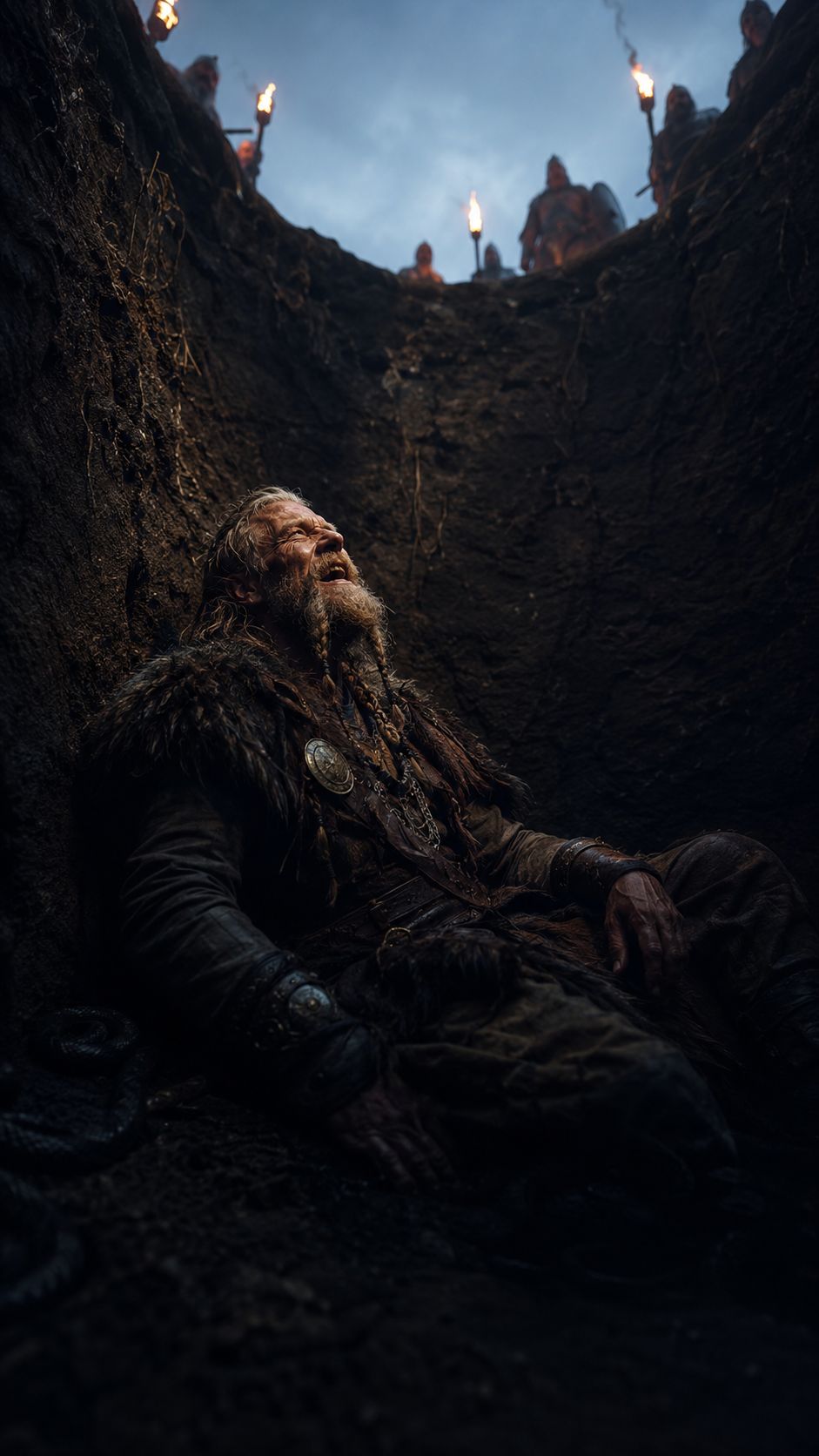
The saga version of events begins with a death. Ragnar, raiding in England, is captured by King Ælla of Northumbria and thrown into a pit of snakes. His sons gather an army to avenge him.
The record does not support this. The Great Heathen Army was real, and the Anglo-Saxon Chronicle notes its landing in East Anglia in 865. The East Anglians gave it horses in exchange for peace, it wintered at Thetford, then turned north. It took York, and the date given for that is November 866. The army’s size is unknown. Estimates run from under a thousand men to several thousand. The annals say nothing about avenging Ragnar. The motive appears only in the later sagas, and its historicity is unknown.
Ælla died in 867. That much is reasonably firm. How he died is where the legend takes over.
The Tale of Ragnar’s Sons says Ivar and his brothers had Ælla’s back carved and his ribs cut loose. This is the “blood eagle”. The victim’s ribs are severed from the spine and spread outward as bloody wings, the lungs pulled out through the wound. In later tellings salt is poured in. Saxo Grammaticus, writing in Latin around 1200, has a version in which the eagle is cut into a captive’s back and the wounds are salted, but he names different sons as the killers. The oldest evidence is a skaldic verse by Sighvatr Þórðarson, composed in the early eleventh century, which says that Ivar cut Ælla’s back. It is cryptic, and its meaning is argued over.
Scholars are divided. Alfred Smyth argued in the 1970s that the rite was real, a sacrifice to Odin. In 1984 Roberta Frank argued that the sagas misunderstood poetry about enemies lying face down with their backs torn by birds, and that the writers borrowed details from Christian martyr stories. Ronald Hutton has called it almost certainly a Christian myth. A 2022 study by Murphy and colleagues found it physiologically possible with Viking-age tools, in versions where death would follow within seconds, but took no position on whether anyone ever suffered it. No English source of the time mentions a blood eagle. It is best read as a possible punishment that a skald described and a saga writer enlarged.
The army moved on. Two years later, in 869 by some reckonings and 870 by others, it returned to East Anglia. Ivar and Ubba are named as the commanders when King Edmund was killed for refusing to renounce Christ, and he was later venerated as Edmund the Martyr. Exactly how he died is not known. The arrows belong to the later legend.
The Legend of the Burial
The sagas add one last story about Ivar. Dying in England, he asks to be buried in a place exposed to attack, believing that his body would defend it. Later in the saga tradition this is tied to William the Conqueror’s landing, which is why it is offered as saga rather than fact. None of it is confirmed.
The Modern Relic
The Great Army spent the winter of 873–874 at Repton in Derbyshire, then a Mercian royal monastery. King Burgred of Mercia was driven out and, in 874, Ceolwulf was installed in his place.
Repton’s church, St Wystan’s, has an eighth-century crypt that is read as a Mercian royal mausoleum. In the seventeenth century a Thomas Walker is said to have opened a burial mound there. Some modern retellings say he found a nine-foot skeleton ringed by hundreds of others, and the story is often dated 1686. No source has been traced for that date, the giant or the stone coffin, so treat those details as local tradition. The Biddles proposed that a central burial in a seventeenth-century report might have been Ivar.
Between 1974 and 1988 Martin Biddle and Birthe Kjølbye-Biddle excavated the site. They found a D-shaped earthwork on the riverbank, and in 1981 they opened a mound west of the church. It had been made from an older building and held the jumbled remains of at least 264 people, about four in five of them men, mostly between 18 and 45. The abstract of their 1992 paper gives the figure as at least 249. Both numbers are in print, because the count was revised.
Close by lay Grave 511. The man in it was older, probably in his late thirties or forties. He was buried with a Thor’s hammer pendant, a sword and a boar’s tusk placed between his thighs. He had been wounded by a spear above the eye and by a deep cut to the thigh. His body showed signs of having been eviscerated, possibly after death. Radiocarbon dates first seemed too early, then, once corrected for the effect of a seafood diet, placed the deaths of this man and a second burial between 873 and 886.
So the grave fits the Army, the winter and the place. It does not prove he was Ivar. The Biddles’ proposal is a hypothesis, and there is no inscription and no DNA link to a named man.
You can visit what is left. St Wystan’s still stands at Repton, with its crypt, and the mound’s site lies beside it. In York, the city Ivar’s army took, the JORVIK Viking Centre reconstructs the streets of Viking Jórvík. The warlord himself may lie beside an English churchyard, or he may have died elsewhere, and the sources that say most about him were written long afterwards.