In the 1630s the town of Loudun, in western France, produced one of the strangest witch trials in European history. It has been retold ever since as a lesson in hysteria and power, most famously in Aldous Huxley’s The Devils of Loudun (1952) and Ken Russell’s film The Devils (1971). At its centre was Urbain Grandier, parish priest of Saint-Pierre-du-Marché and a canon of Sainte-Croix. He was clever, worldly and, by most accounts, vain. A son born around 1629 or 1630 to Philippa Trincant, a local girl, was widely believed to be his, and he was thought to have had other liaisons. He also made enemies, and one of them was the most powerful man in France.
The Horror
The Ursuline convent at Loudun had opened in 1626. In 1632 it held seventeen nuns under the prioress, Jeanne des Anges. Around then the sisters began to convulse, scream and speak obscenities, and to claim that they were tormented by demons. They named Grandier as the man who had sent them.
Why they named him is disputed. Huxley says Jeanne was enraged when Grandier refused to become the convent’s spiritual director. The older account of des Niau says Grandier did apply, and that the post went to Canon Jean Mignon, a nephew of the Trincant family. Both versions are partisan, and the sources do not settle the matter. Exorcisms began, and in time they became public spectacles. Later readers have seen mass hysteria, suggestion, or a deliberate performance. Michel de Certeau treated the whole affair as political theatre.
The politics were real enough. Grandier had backed the town in resisting the demolition of Loudun’s defences, which the Crown wanted gone, and he is said to have written something against Richelieu, though the sources consulted do not name or date it. Jean de Laubardemont, a relative of the prioress, was sent to carry out the demolition and was then commissioned in November 1633 to investigate the possessions. Grandier was imprisoned at Angers. A Council decree of May 31, 1634 confirmed Laubardemont’s powers and forbade other courts from interfering, with a fine of five hundred livres for anyone who appealed. The Archbishop of Bordeaux had earlier ordered the nuns separated, after which the fits reportedly stopped, and letters from the bailly of Loudun calling the possession an imposture were intercepted. Historians still debate how far Richelieu himself drove the case. That he did is often stated, but it is hard to prove from the sources consulted.
The evidence produced against Grandier included papers said to be a pact with the Devil. One was in Latin and supposedly signed by Grandier. Another, almost illegible, carried symbols and the “signatures” of Satan and other demons. Whether he signed under duress or whether the papers were forged is unknown. One account adds that the prosecution explained how they came to hand by saying a demon had stolen the pact from Lucifer’s files.
He was condemned and put to the question before his death, which in the French courts meant torture to extract the names of accomplices. He was given the brodequins, boards bound round the legs with wedges hammered between them. One account says the bone marrow oozed from his broken limbs. He named no one and kept his innocence to the end.
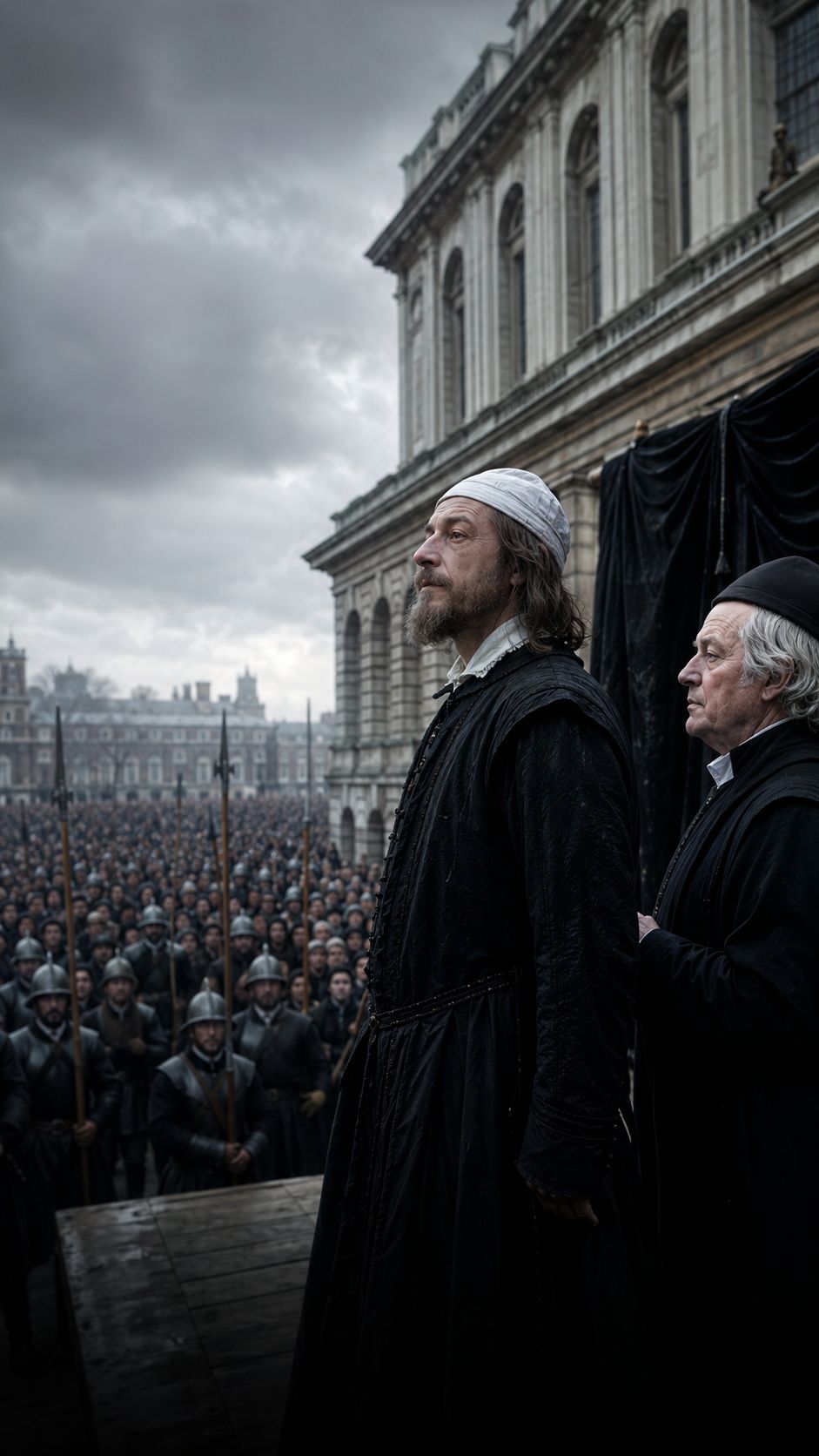
On August 18, 1634 he was burned alive at Loudun. One French encyclopaedia entry places the burning in the square of Sainte-Croix, but no second source confirms it. The details of the pyre are contested, and the sources do not agree. Robert Rapley’s version is that Grandier was to be hanged first as a mercy, but the Capuchin exorcist Lactance lit the fire early and he burned alive. The older des Niau version is that the rope burned through and he fell alive into the flames. In both accounts, monks threw holy water in his face, so that whatever he tried to say could not be heard. His last words are not reliably recorded.
The Aftermath
If the purpose was to be rid of one priest, the demons should have left with him. They did not. Jeanne des Anges went on being tormented, and the exorcisms continued until about 1637. The Jesuit Jean-Joseph Surin was sent in. Afterwards the names Jesus, Mary, Joseph and Father Sales appeared in red on her hand, and she toured France showing it as a celebrity. Surin himself suffered for around twenty years from despair and breakdown, which he attributed to her demons. For later writers, from Locke in 1679 to Calmet and the Enlightenment, the survival of the possession after Grandier’s death was the clearest sign that the case had been a contrivance.
The Modern Relic
The documents are the most uncertain relic. One source says both alleged pacts survive in the Bibliothèque nationale in Paris, and they are often reproduced as images. Neither the shelfmark nor the holding could be confirmed from any other page, and the images in circulation may derive from a 19th-century printed copy, so treat the claim as unverified until checked against the BnF’s own catalogue.
Loudun itself is a small town in the Vienne department, and its association with Grandier has never gone away. The sources consulted give no precise list of what can be visited, so no site is recorded here. The case lives on mainly in culture: Huxley’s book, John Whiting’s play The Devils (1961), the Polish film Mother Joan of the Angels (1961), Krzysztof Penderecki’s opera The Devils of Loudun (1969) and Russell’s film all return to the priest who was burned on the word of nuns he may never have touched. That last claim, that Grandier never met Jeanne des Anges, is repeated in popular tellings, but none of the sources consulted supports it, so it is left as tradition.