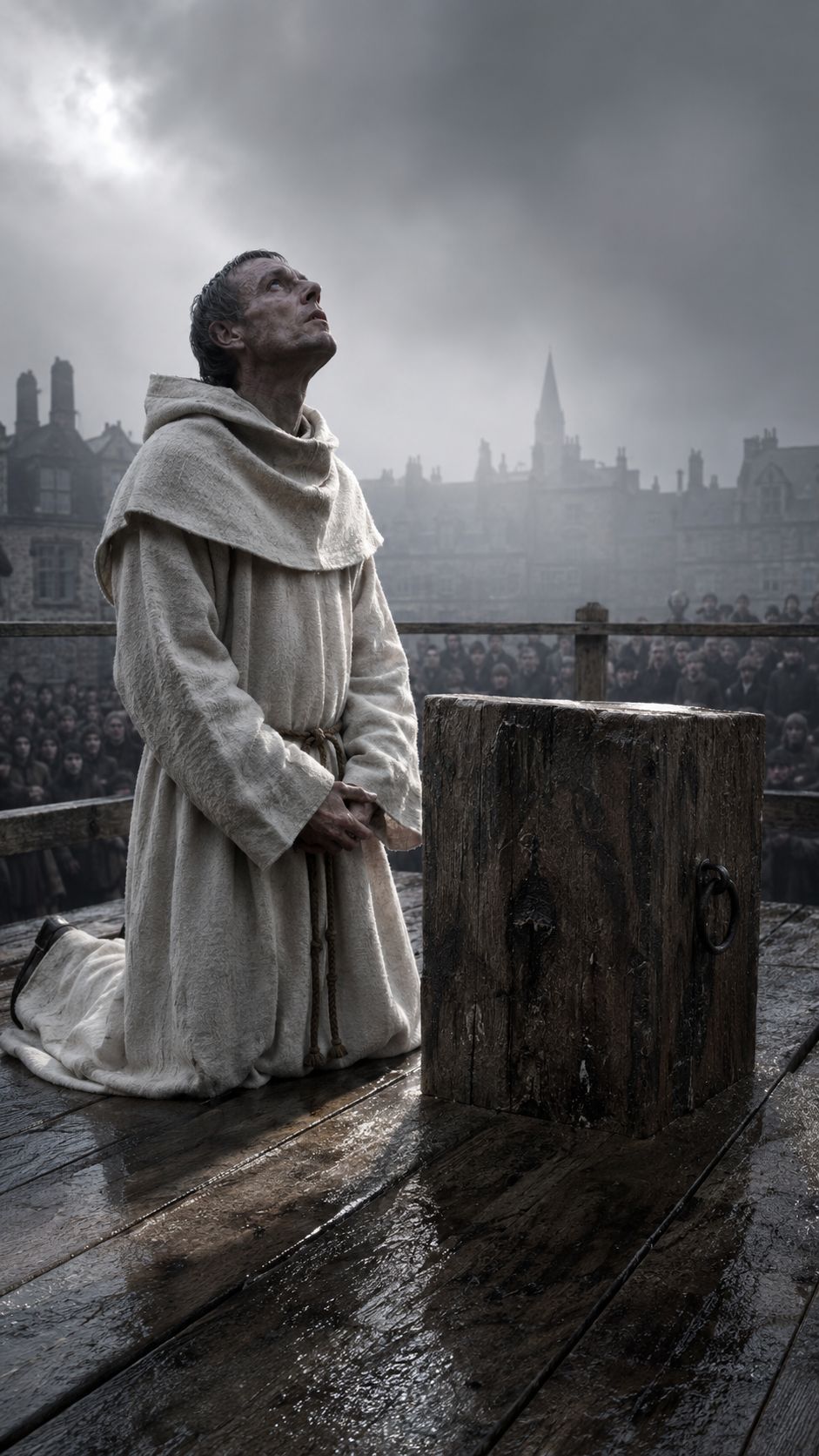
Most of the priests England put to death are known only through records and a feast day. John Southworth is different: his body survived, was lost, and was found again, and it lies in a London cathedral.
The Horror
John Southworth was born about 1592 in Lancashire, into a family at Samlesbury Hall that chose to pay heavy fines rather than give up the Catholic faith. He studied at the English College at Douai in northern France and returned to England as a priest on October 13, 1619. In 1624 he was recalled to serve as chaplain to Benedictine nuns in Brussels for about a year, then returned to Lancashire. He was arrested in 1627 and held in Lancaster Castle. He was later moved to the Clink in London and sentenced to death for professing the Catholic faith. In 1630, at Queen Henrietta Maria’s insistence, he and seventeen others were handed to the French ambassador and deported.
By 1636 he was back, living in Clerkenwell. During a plague epidemic that year he and Henry Morse tended the sick in Westminster and raised money for victims’ families. He was arrested again in November 1637 and held at the Gatehouse Prison and then the Clink. In all he was arrested four times. Three times the Secretary of State, Sir Francis Windebank, released him at the Queen’s direction, and on the fourth occasion he escaped. From 1640 until 1654 he continued a clandestine ministry.
He was arrested for the last time under the Interregnum and tried at the Old Bailey under Elizabethan anti-priest legislation. He pleaded guilty to exercising the priesthood and was sentenced to be hanged, drawn and quartered. The sentence was carried out at Tyburn on June 28, 1654, when he was about sixty-two.
His death did not end the story. The Spanish ambassador arranged for his body to be returned to Douai, where it was sewn together and parboiled to preserve it. It was buried there, and after the French Revolution the remains were buried unmarked to protect them. The grave was found in 1927 and the remains were returned to England.
The Legend
A popular retelling has the judge begging him to deny his priesthood and Southworth refusing. The sources consulted here record only that he pleaded guilty to exercising the priesthood, so the judge’s reluctance is unconfirmed. Accounts also vary on who physically recovered the body, and the Spanish ambassador’s involvement is the only detail given. The circumstances of the 1927 rediscovery, including the claim that it came during building work, are unconfirmed.
The Modern Relic
John Southworth was beatified on December 15, 1929 by Pope Pius XI, and canonised on October 25, 1970 by Pope Paul VI, as one of the Forty Martyrs of England and Wales. He is a patron saint of priests. His feast day is June 27 in the Diocese of Westminster.
His relics are kept in the Chapel of St George and the English Martyrs in Westminster Cathedral, where a reliquary is displayed, close to the district where he nursed the plague-sick. The Guild of Saint John Southworth, established there in 2014, offers free guided visits through its volunteers.