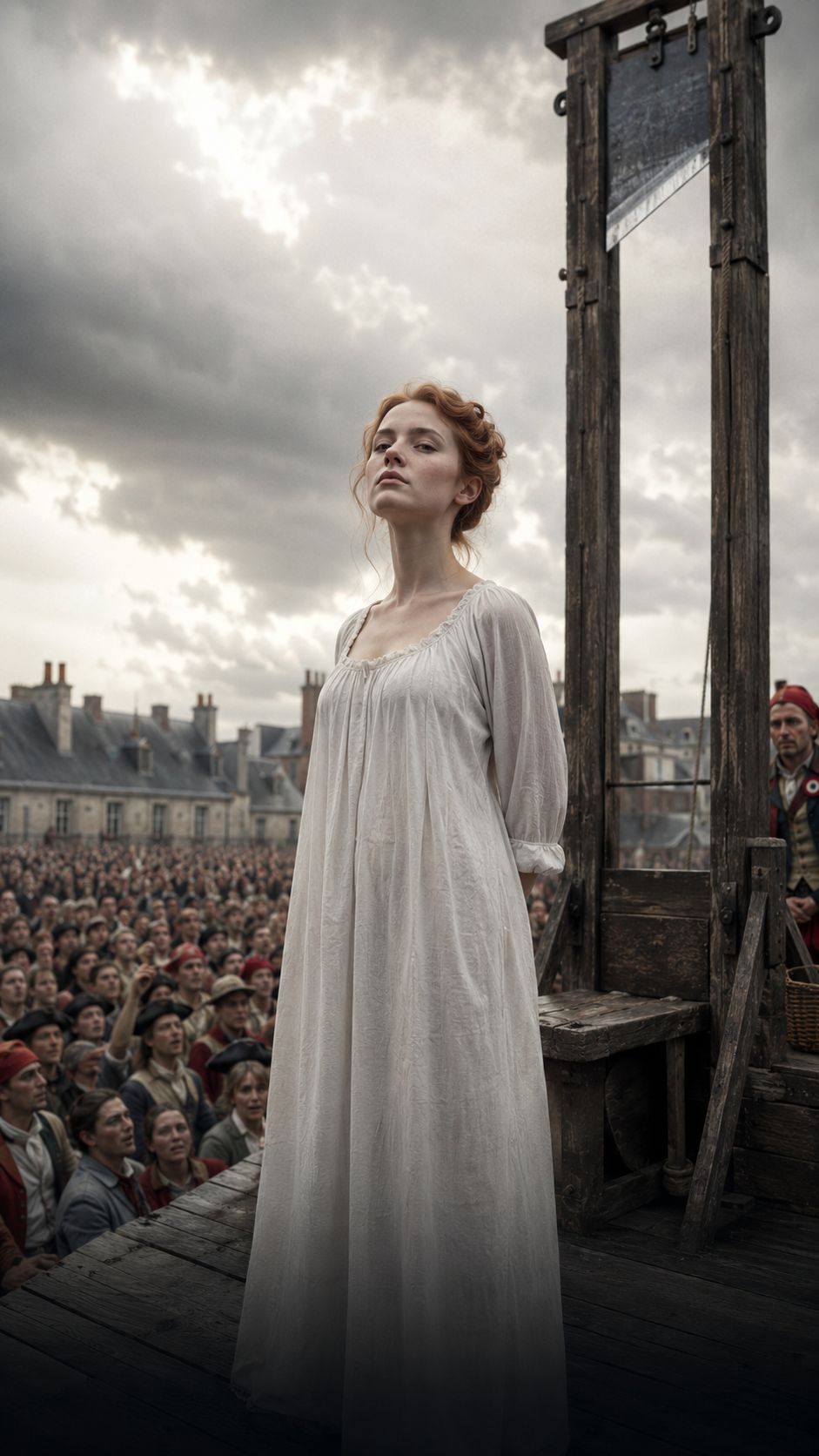
Louis-Charles was the second son of Louis XVI and Marie Antoinette, born at Versailles on March 27, 1785. His elder brother died in 1789 and he became Dauphin. After his father went to the guillotine on January 21, 1793, royalists called him King Louis XVII. He never ruled, because France was a republic, but to the men who held him in the Temple tower in Paris he was a living claim to the throne.
The Horror
The royal family was imprisoned in the Temple in August 1792. On July 3, 1793, the boy, then eight, was taken from his mother and placed in the custody of Antoine Simon, a cobbler appointed by the Committee of Public Safety. On October 6, 1793, officials including Pache, Chaumette and Hébert obtained his signature on a statement accusing his mother and aunt of sexual misconduct. Marie Antoinette was executed ten days later.
The Simons left the Temple on January 19, 1794. What followed is usually told as six months alone in a shuttered, filthy room, fed through a grille and untreated for illness. This is documented only in part. The harrowing detail comes largely from accounts written under the Restoration, and the full picture is disputed. What is better established is that Barras, appointed after the fall of Robespierre, visited the Temple on July 27, 1794 and found the boy severely neglected.
A guardian, Étienne Lasne, took charge on March 31, 1795. The boy fell seriously ill in May. The doctor Pierre-Joseph Desault was called but died suddenly on June 1, possibly by poison, which is unconfirmed. Louis-Charles died in the Temple on June 8, 1795, aged ten. The official cause was scrofulous tuberculosis. He was buried the next day or two days later in an unmarked grave at the Sainte-Marguerite cemetery. Sources differ on the date of the autopsy. It was carried out by the surgeon Philippe-Jean Pelletan.
The Legend
The heart’s later history is partly documented and partly told as legend. It is recorded that Pelletan took the heart at the autopsy and kept it, first in alcohol, which evaporated and left it dry. The popular version adds that he stole it behind his colleagues’ backs, and that a student later took it and confessed on his deathbed. Neither of these details is confirmed in the sources used here. They should be read as story rather than record.
Rumour held that a dying child had been substituted for the prince and that the real Louis XVII was smuggled out. The claimants who followed were many. Baron de Richemont began pressing his claim in Paris in 1828 and died in 1853. The German clockmaker Karl Wilhelm Naundorff appeared in Paris in 1833, was expelled in 1836 and died in Delft in 1845. The missionary Eleazer Williams of Wisconsin was another, a claim generally regarded as false.
The Modern Relic
After 1815, Pelletan offered the heart to Louis XVIII, who refused it. He gave it to the Archbishop of Paris, Hyacinthe-Louis de Quélen. After the archbishop’s palace was plundered in 1830, Pelletan’s son recovered it. It then passed through a succession of owners, among them Édouard Dumont and Carlos, Duke of Madrid, and later members of the Bourbon-Parma and Massimo families, until it reached the Basilica of Saint-Denis.
In December 1999 a section of the heart’s aorta was removed under notarial supervision. In 2000, mitochondrial DNA tests on the heart and on bone samples from Naundorff reported that Naundorff was not the Dauphin and that the heart was Louis-Charles’s. The dates and sequence of the tests are not settled in every source.
On June 8, 2004, the heart was buried at Saint-Denis beside the remains of Louis XVI and Marie Antoinette. The basilica is also where the revolutionary government threw the royal dead into lime trenches in 1793. The bones of 158 bodies were gathered into an ossuary in 1817 and sealed behind marble plates bearing their names. The heart was placed in a crystal vase in the crypt wall. The Temple tower, where he died, no longer stands.