Most English schoolchildren can name the kings of the Plantagenet line. Far fewer know the woman who, on the strict rules of inheritance, stood ahead of King John. Eleanor of Brittany spent almost all of her adult life in the custody of the men who wore the crown she might have claimed. She never stood trial, and no crime was ever laid against her.
The Horror
Eleanor was born around 1184, the daughter of Geoffrey, Duke of Brittany, a son of Henry II. That made her a niece of both Richard I and John. When Richard died in 1199 without a legitimate child, the succession fell between John and Eleanor’s younger brother Arthur, whose claim descended through the elder brother Geoffrey. John took the throne. Pope Innocent III is recorded as arguing that Eleanor had a better claim than John, though the barons later chose Henry III instead.
The date and place of her capture are unknown. She may have been taken with Arthur around the Battle of Mirebeau in August 1202 or at some other point. What is documented is that in December 1203, when John fled Normandy, he took Eleanor with him as a prisoner. Arthur had disappeared in captivity that same year. His fate is unconfirmed, though the belief that John had him killed is long-standing.
From then on she was moved between royal strongholds. Wikipedia lists Brough Castle in Cumbria for a short time in 1206, Bowes, Corfe Castle in Dorset, where she lived in the Gloriet Tower, and later Gloucester, Marlborough and Bristol. Sources disagree on the sequence, and one account places her at Bristol for nearly forty years. In 1208 she wrote a letter asking the clergy and barons of Brittany to come to England and negotiate her release. It is the only surviving document written by her. John gave her the titles Duchess of Brittany and Countess of Richmond, but only as titles, and her half-sister Alix became duchess in practice.
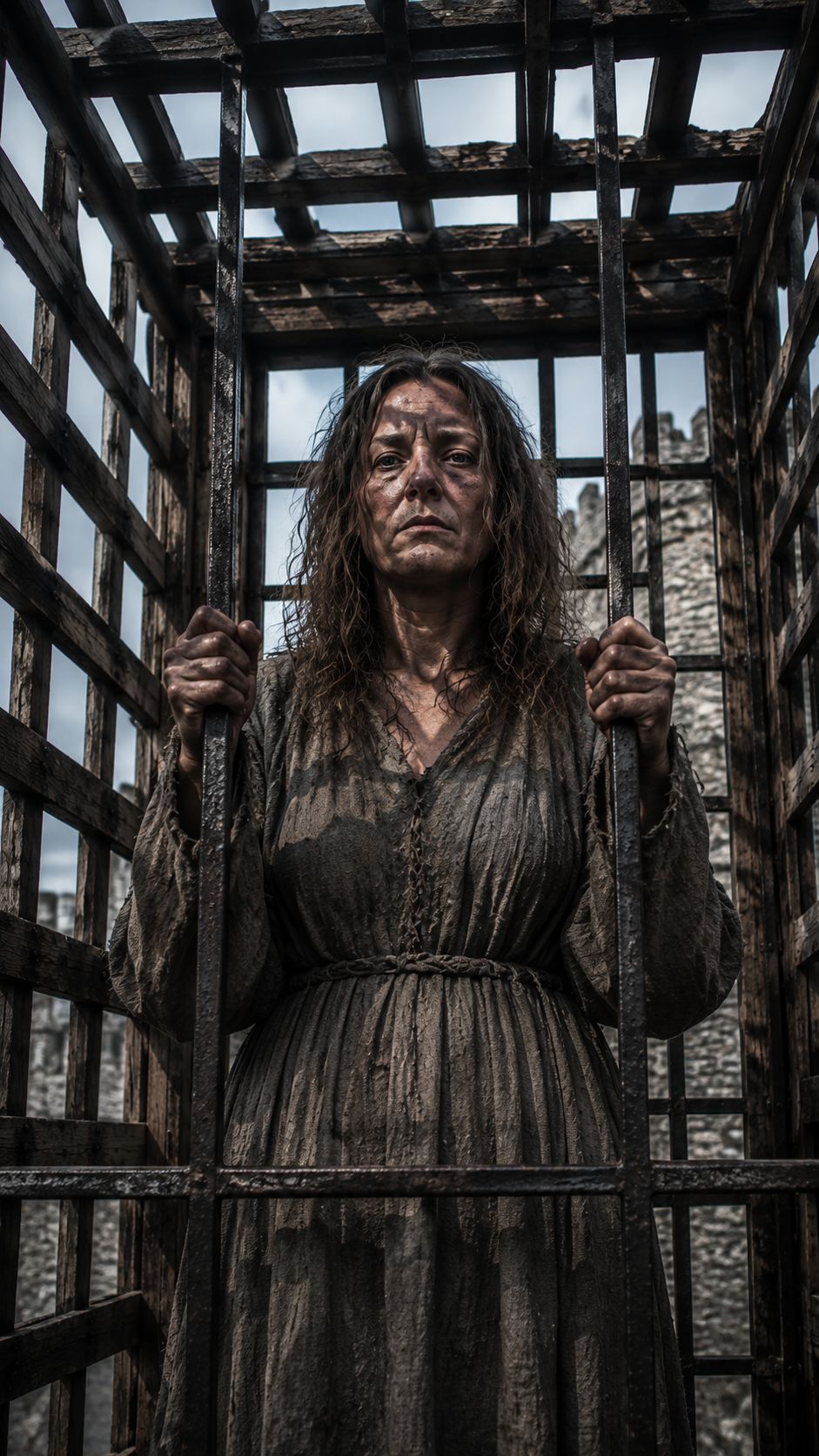
Her situation did not improve when John died in 1216. She was left out of the release of hostages under Magna Carta in 1215, and Henry III kept her in custody for the whole of his long reign. The records show comfort of a kind. She had her own apartments, attendants and gifts of food and clothing, and an allowance of 20 marks a year from 1225, raised to 25 in 1229. They also show locks, keys and tower access at Bristol in 1225 to 1227, which may mean she was kept in a locked room or tower at times. In 1218 she lost the Richmond title when Peter of Brittany was recognised as earl, and Henry called her “king’s kinswoman” or “our cousin” rather than duchess. He never supported her claim to Brittany. Her marriage, which any rival would have used to gain her claim, never took place, although several matches had been discussed earlier in her life.
Eleanor died on 10 August 1241, aged about 57 to 59, as a nun. The place of death is uncertain: Bristol Castle is the usual statement, but Corfe is also mentioned. She was first buried at St James’ Priory in Bristol and later reburied at Amesbury Abbey in Wiltshire, as she wished. Henry III paid for masses in her memory at Marlborough in 1246 and at Bristol in 1250.
Nothing in the surviving record shows violence done to her. What it shows is a woman whose existence was a political problem, and who was kept out of sight for close to forty years because of it.
The Modern Relic
Corfe Castle is a ruin on the Isle of Purbeck in Dorset, owned by the National Trust and open to visitors, with its keep reopened in 2024 after conservation work. The Gloriet Tower is the part associated with Eleanor, and Wikipedia says that both John and Henry III held her there until 1222.
Eleanor herself has no monument. Neither St James’ Priory in Bristol nor Amesbury Abbey has a memorial to her remains. In 1268 Henry gave the manor of Melksham to Amesbury for the souls of Eleanor and her brother Arthur, a small and late gesture towards a woman he had never set free.
A story in the Chronicle of Lanercost that she was once crowned in gold exists in two versions, one saying she wore the crown for only a day. It is unconfirmed.