In the first months of 1874, six men walked into the San Juan Mountains of Colorado. Ten weeks later one of them walked out, well fed, carrying money that was not his, and began telling a story that would not stay the same. Alferd Packer admitted from the start that he had eaten the others. What the courts and historians have argued over for 150 years is whether he also killed them.
The Horror
The expedition began in Utah in November 1873. A party of about 20 men set out for the Colorado goldfields, and Packer, a Civil War veteran, joined near Provo, presenting himself as a man who knew the mountains. Later accounts say his companions found him greedy, lazy and quarrelsome, and doubted that he knew them at all.
On January 21, 1874 the party reached the camp of Chief Ouray, near present-day Montrose. Ouray advised them to wait for spring. Eleven men pressed on regardless and split into two groups. Five followed the Gunnison River. Six took the high route with Packer: Israel Swan, James Humphrey, Frank Miller, George Noon and Shannon Wilson Bell. They left on February 9 for the Los Piños Indian Agency, about 75 miles away, with roughly two weeks of food and no snowshoes.
On April 16, 1874, Packer arrived at the agency alone, 65 days later. He was not the wasted figure the story demanded. He gave a first account, taken down by the agency clerk, and then revised it. In the versions that survive he blames the winter and then Bell: the men starved or froze one by one, or Bell went mad and killed the rest, and Packer shot him in self-defence. Every version admitted that he had eaten human flesh to live. Taking that at its word, cannibalism of necessity was not a hanging offence. Murder was.
The thaw gave the mountains up. In August 1874 the illustrator John Randolph found the five bodies together at a camp on the slopes above what is now Lake City. A short account at the site says most appeared to have been killed in their sleep, with one showing signs of a struggle. That sat badly with a story of men dying separately in the cold. By then Packer had been taken into custody, and he escaped at Saguache.
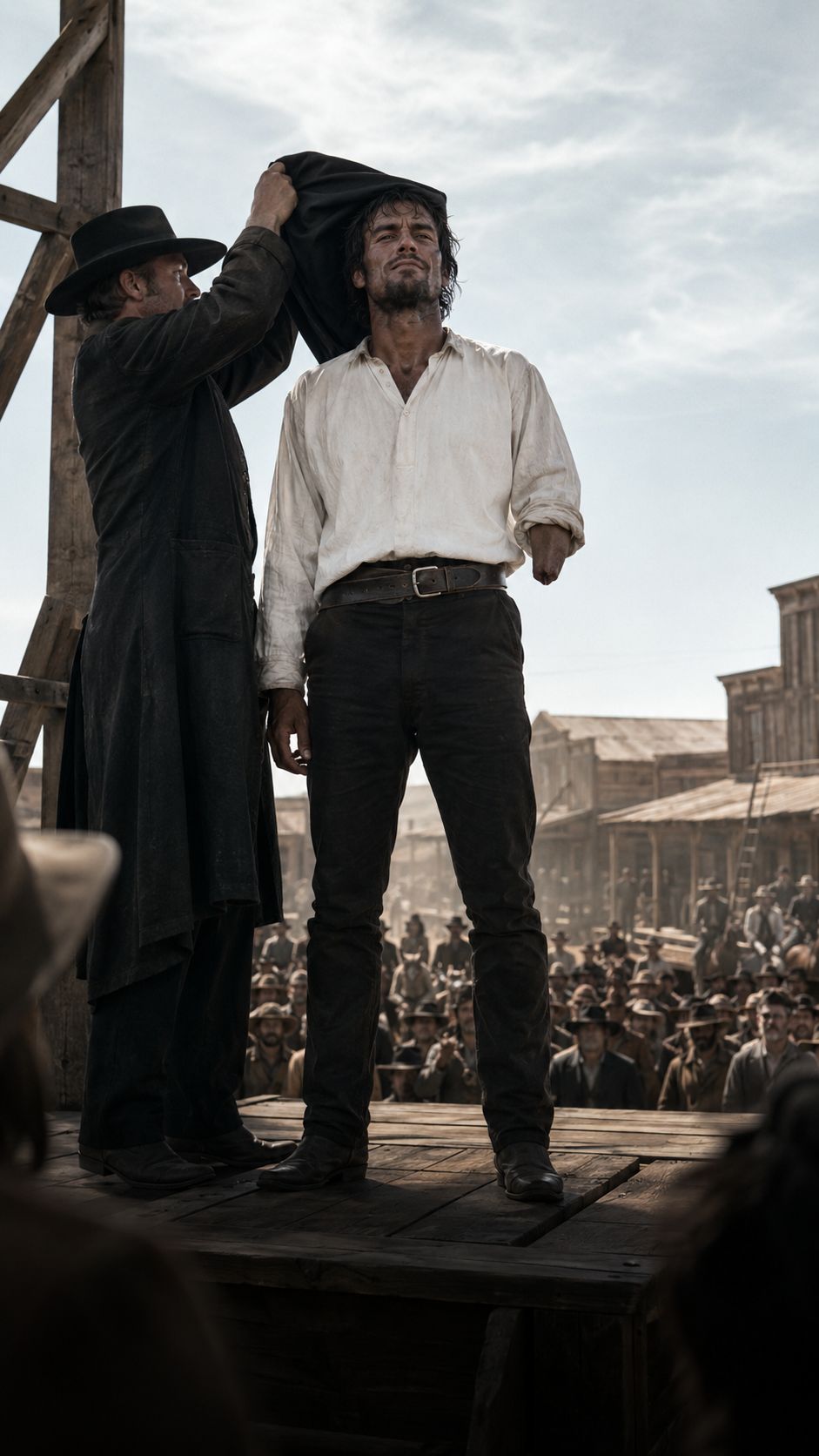
He stayed gone for years. On March 11, 1883, a man who had known him identified him in Cheyenne, Wyoming, living as “John Schwartze”. He signed a second confession in Denver on March 16. His trial opened at Lake City on April 6, 1883, before Judge M. B. Gerry. He was convicted of the premeditated murder of Israel Swan and sentenced to hang on May 19, 1883.
Then the law caught up with the law. In October 1885 the Colorado Supreme Court overturned the sentence, on the ground that the murder statute he was tried under had not been in force when the killings took place. The Littleton Museum puts it as an error in the criminal codes at statehood. The sources differ on the wording, but they agree that he got off the gallows on a technicality, not on the facts. He was retried at Gunnison and on June 8, 1886 was convicted of five counts of voluntary manslaughter, eight years for each, forty in all. He entered the penitentiary at Cañon City.
The Legend
The best-known line from the case belongs to the sentencing: that Judge Gerry told him there were only seven Democrats in Hinsdale County and Packer had eaten five of them. It is told in many forms. One source reports a dialect version relayed secondhand through a newspaper, and says the official court record of the sentence is plainly worded and not political. Treat it as local tradition. No contemporary transcript has been found, and it is not in the Littleton Museum’s account at all.
Two other tales are told of his last years. One is that he became a gentle old man who dandled children on his knee, which the Littleton Museum attributes to a local historian’s description. The other, that he turned vegetarian, is often repeated, and no source for it has been found.
The Modern Relic
Polly Pry of the Denver Post campaigned for his release, and Governor Charles Thomas paroled him on February 8, 1901, after about 18 years in prison. Thomas paroled him but did not pardon him. He worked briefly as a guard at the Post building, then lived out his days around Littleton. He died in April 1907. Sources give April 23 and April 24, and one records the cause as dementia, another liver and stomach trouble. The military paid for his funeral and for a headstone reading “Co. F, 16 U.S. Inf.” in Littleton Cemetery. In 1973 the grave was cemented over, to keep souvenir hunters out of it.
The bones were not left alone either. In July 1989 a team under the law professor James Starrs exhumed the five victims. Blunt-force damage to skulls and hacking marks on Bell’s forearms were read as signs of a violent attack, and Starrs pronounced Packer “guilty as sin”. His colleague, the forensic anthropologist Walter Birkby, disagreed: in his view the bones neither confirmed nor refuted Packer’s account. A hole in Bell’s hip became the argument. Starrs thought an animal’s fangs had made it. The curator David Bailey suspected a bullet, tracked down an 1862 Colt revolver with a card tying it to the site, and found a lead fragment in Bell’s preserved samples that matched its ammunition. That evidence fits Packer’s claim that he shot Bell in self-defence. It does not prove it, and a local historian is not convinced the revolver is genuine. Wikipedia goes further and says cannibalism itself could not be scientifically proven. That claim appears in a single source, and the other sources take cannibalism for granted.
The site is on a bluff just outside Lake City, near the Cannibal Plateau, which is named for him. A memorial tablet stands there and a user-submitted listing records free public access, though a conflicting note says the land may be private, so check locally before you go. The story has been well used since. Students at the University of Colorado Boulder founded the Alferd G. Packer Memorial Grill in 1968 with the slogan “Have a friend for lunch!”, and Trey Parker’s first feature, Cannibal! The Musical, was released in 1993.